
Khao Yai Travel Guide · Chapter 3 of 8
Inside Khao Yai National Park: Entry, Rules and What You'll Actually See
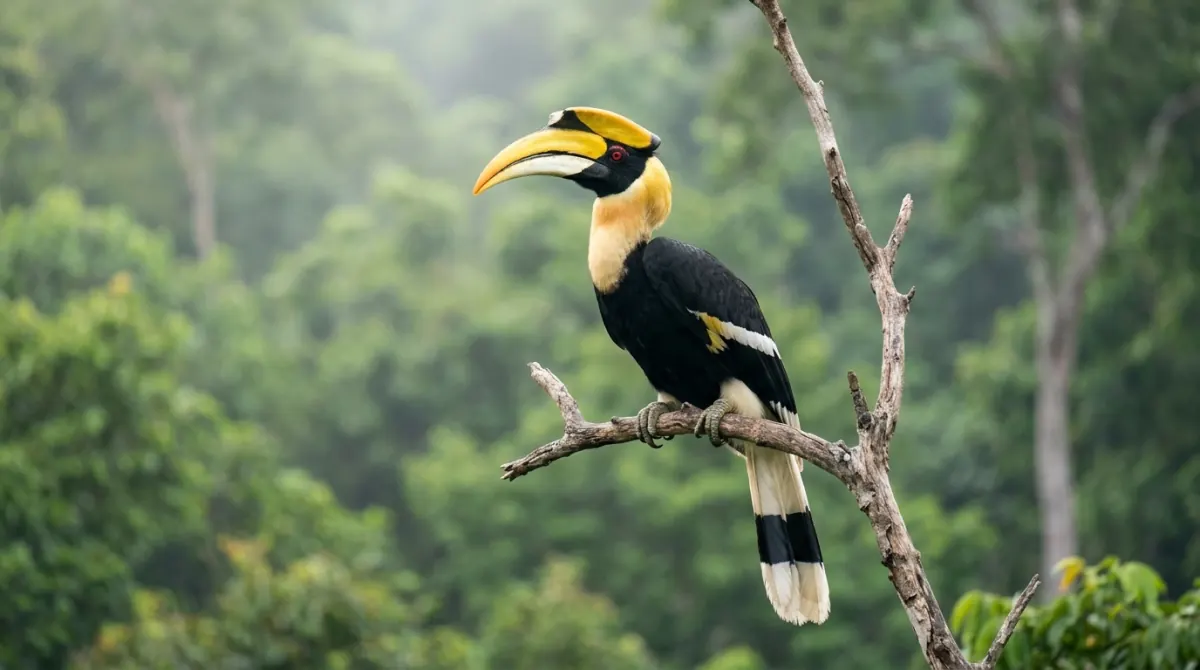
Foreign adults pay 400 THB (about US$12) to enter Khao Yai, children 200 THB, plus 30 THB for a car. Thai nationals pay 40 THB. Gates open 06:00–18:00 and one ticket covers a single day. Macaques and deer are near certain, gibbons and hornbills likely, wild elephants possible but never guaranteed.
At a glance
| Item | Detail |
|---|---|
| Foreigner adult entry | 400 THB (~US$12) |
| Foreigner child entry | 200 THB (~US$6), roughly ages 3–14; under 3 free |
| Thai adult / Thai child | 40 THB (~US$1.20) / 20 THB |
| Car (4 wheels) / motorcycle | 30 THB (~US$0.90) / 20 THB |
| 6-wheel / more than 6 wheels | 100 THB / 200 THB |
| Gate hours | 06:00–18:00, daily, year round |
| Visitor Centre desk | 08:30–16:30 |
| Ticket validity | One calendar day; leaving and re-entering the same day is fine |
| Night safari | 600 THB per truck (not per person), maximum 8; 19:00 and 20:00 departures; book at the desk by 16:30 |
| Ranger guide | No published tariff. Traveller reports run from roughly 500 to 1,000 THB per group; confirm at the Visitor Centre desk when you register |
| Entrances | Chao Por Khao Yai Shrine (north, Pak Chong) · Noen Hom (south, Prachinburi) |
| North gate to Visitor Centre | 14 km |
| Best months for wildlife | November–February |
| Park information | 086-092-6529 (08:30–16:30) · 24-hour emergency 086-092-6527 |
Entrance fees, and the two-tier price
The standard foreign rate across Thai national parks is 200 THB adult and 100 THB child. Khao Yai's two staffed entrances are designated "special service fee" sites, and a Department of National Parks announcement of 19 September 2022 doubled the rate there to 400 THB adult and 200 THB child. Thai nationals pay 40 and 20 THB — a tenth of the foreign rate, which nobody warns you about before the barrier. Thai citizens over 60, people with disabilities, monks and children under three enter free; foreign seniors and disabled foreign visitors pay the full 400 THB. Only a Thai passport or ID card gets the Thai rate — a work permit or driving licence has not counted since 2015.
Vehicles are cheap by comparison — 30 THB for a car, 20 THB for a motorcycle, more for larger vehicles. A family of four foreigners in a car pays 1,230 THB (about US$37) at the barrier, and at that price the ticket only earns its keep if you use the ends of the day. Arrive at 11:00, leave at 15:00, and you have paid the full 1,230 THB for the four hours when the forest is quietest and the animals are least visible.
Bring the fee in cash — 400 THB a head in notes. The gate also takes QR payment through the DNP's QueQ app, but it needs a phone signal, and nobody publishes whether it accepts a foreign card or a non-Thai phone number, so do not arrive relying on it. Cash, signal and what does and does not work inside the park are covered in Eating, Sleeping and Practical Khao Yai.
The 16:30 desk closes before the 18:00 gate
The park is open 06:00 to 18:00 every day of the year, and the fee is charged per day.
One ticket covers entry and exit on a single calendar day, so you can drive out for lunch and come back on it; a second day means paying again. If you have booked a bungalow or campsite inside, the ticket is generally accepted for three days, though the park's fee page does not say so.
No last-entry time is published anywhere. Gates shut at 18:00 and late arrivals are turned away, bungalow booking or not. The second deadline is quieter and bites harder: the Visitor Centre desk closes at 16:30, and that is where you collect bungalow keys, register for a ranger-guided trail and book the night safari. Arrive at 17:00 with a reservation and you are inside the park with nowhere to check in. Vehicles already inside may leave after 18:00 — the restriction is on entry.
What you will actually see
Khao Yai is a working forest, not a safari park, and the hour of the day matters more than luck.
| Animal | Realistic odds |
|---|---|
| Pig-tailed and long-tailed macaques | Near certain — around the gates and roadside verges |
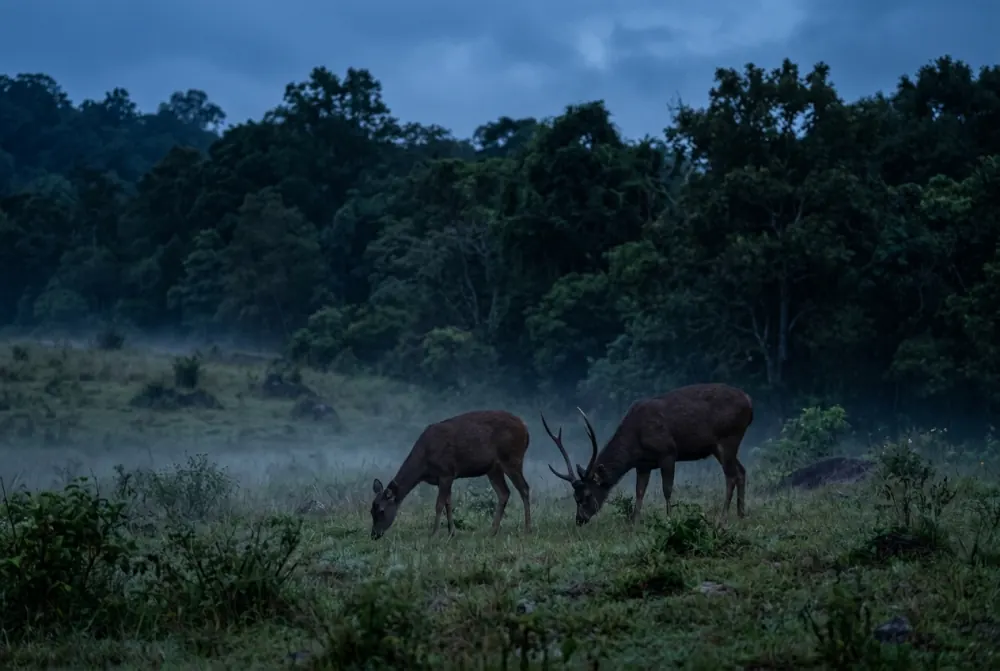
| Sambar and barking deer | Very likely — HQ lawns, Nong Phak Chi grassland, verges at dawn and dusk |
| White-handed gibbons | Heard at dawn almost every morning; seen far less often, being high in the canopy |
| Great and Oriental pied hornbills | Likely over a full day, usually flying between fruiting trees |
| Wreathed and brown hornbills | Unlikely unless a guide knows a nest site |
| Civets, porcupine, owls, nightjars | Common on the night safari, rare in daylight |
| Black giant squirrels, junglefowl, monitor lizards | Frequent |
| Wild elephants | A genuine possibility, never a guarantee |
| Gaur, dhole, jackal, bears, wild cats | Bonus sightings. Most visitors never see one |
On elephants, be sceptical of anyone quoting a percentage: no credible source publishes one. The park holds a few hundred across 2,168 square kilometres of mostly closed-canopy forest. What is established is what improves the odds — late afternoon and dusk on the park roads, the grassland by the Nong Phak Chi tower, a night safari, a ranger-guided walk, more than one day, and the cool dry season from November to February, when animals gather at waterholes. A midday drive-through is a poor bet, and sightings are often partial: brown and grey behind foliage, not the open-road photograph you have seen online.
Two Siamese crocodiles live in the Lam Takhong stream near the Visitor Centre, with signs posted — one of several reasons for the park-wide swimming ban, covered in the waterfalls chapter.
Nong Phak Chi: the grassland tower, and the catch
Nong Phak Chi is the name that comes up whenever anyone talks about wildlife in Khao Yai, and it is rarely explained. It is an area of open grassland with a salt lick and a wooden observation tower, reached from the park road at the km 33 marker. The tower looks out over grass to the forest edge, which is why it works: everywhere else in the park you are peering into closed canopy, and here the animals are standing in the open.
What you realistically see from the platform at first light is sambar and barking deer out on the grass, macaques crossing it, gibbons calling from the trees behind and hornbills over the tree line. Elephants use the salt lick, which is where the reputation comes from, but plan for an hour of watching deer and treat anything larger as the exception.
The catch is a scheduling one. Both marked routes to the tower need a ranger — Trail 3 from the km 33 marker, 4.2 km, and Trail 5 in from Dong Tiw, 5.5 km — and rangers are arranged in person at the Visitor Centre desk, which does not open until 08:30. A guided walk to the tower therefore cannot start at dawn, and by the time you arrive the best light and the best hour are gone.
Several sources describe a short walk in to the tower from the roadside at km 33 with no guide, and the park publishes nothing that either confirms or forbids it. Treat it as unconfirmed rather than as a plan: ask at the Visitor Centre or on 086-092-6529 the day before, and keep the park roads themselves as the fallback, since that is where most first-light and dusk sightings happen anyway.
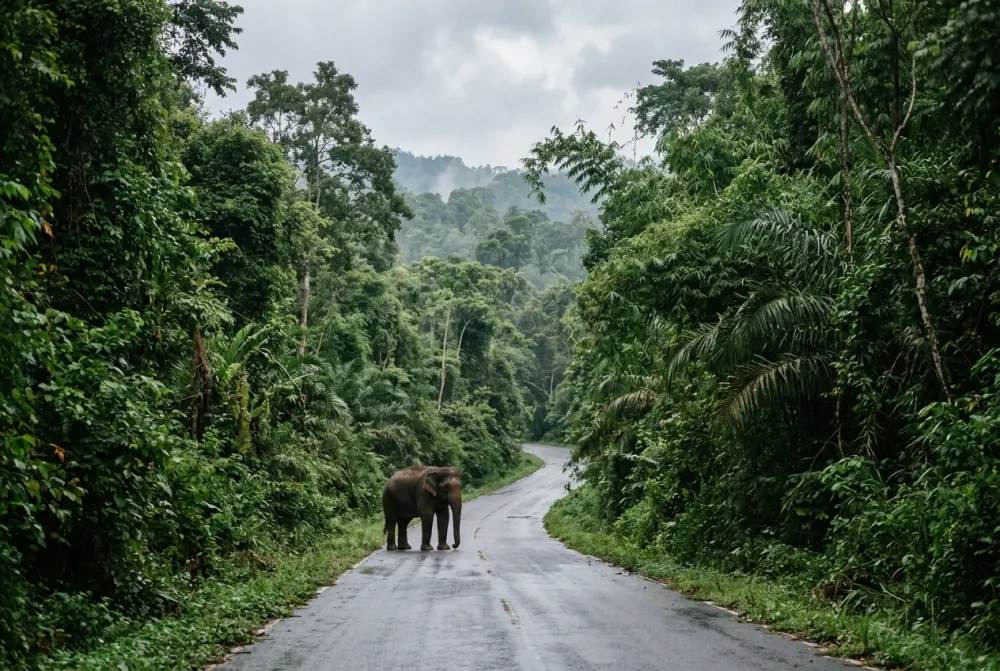
When an elephant is on the road
Follow the park's own instructions, which contradict several widely read travel blogs.
- Stop at least 30 metres away and stay in the vehicle.
- Keep the engine running and the headlights on. Do not switch either off. At night, dip the headlights and do not use indicators.
- No horn, no revving, no shouting, no flash — and do not get out to photograph.
- If it comes closer, reverse away slowly.
- Do not squeeze past. An elephant walking down the road has the road.
- If surrounded, drive very slowly toward the side with fewer animals, engine as quiet as possible.
A car that goes silent and dark becomes an unidentified object at close range, and a startled or cornered elephant charges. Revving and horns read as a challenge, not a request to move. Your car protects you only while it can move, which is why reversing beats waiting.
Park roads are posted at 60 km/h — slow enough to stop for an animal standing in the road, and the figure every in-park drive time in this guide is estimated from. The rest of the road rules, the enforcement and the after-dark hazards are in Getting to Khao Yai.
Night safari, trails and ranger guides
The night safari is the only legal way to look for wildlife after dark — taking your own vehicle out on the park roads at night carries a fine reported at 500 THB, which is set out with the other road rules in Getting to Khao Yai. Rangers run an open high-bed pickup with a spotlight along a fixed 10 km route, about an hour. It costs 600 THB (about US$18) per truck, not per person, maximum eight — roughly 75 THB each at capacity. Two slots run nightly, 19:00–20:00 and 20:00–21:00.
Book in person at the Visitor Centre desk on the day, and remember the desk shuts at 16:30. There is no online booking and no reservation by phone.
The park does not publish whether the desk pools walk-ups into a shared truck or sells you the whole vehicle, so the price per head can swing eightfold and you cannot resolve it in advance. Budget the full 600 THB and treat 75 THB each as the best case rather than the price. If it matters to your budget, ask at the desk when you book whether anyone else is on the same slot.
It reliably produces sambar deer, plus a fair chance of porcupine, civets and owls. Elephants happen but are not the norm. A spotlight, a diesel engine and seven strangers on a bench is not a nature documentary, and two people paying the full 600 THB get middling value. Split eight ways it is one of the better deals in the park. Take a warm layer.
Seven trails are numbered; three you may walk alone:
| Trail | Distance and time | Guide |
|---|---|---|
| 1. Visitor Centre – Kong Kaew Waterfall | 1.2 km circular, 45–60 min | Not required |
| 2. Pha Kluai Mai campground – Haew Suwat | 3 km, about 2 h | Not required |
| 3. Km.33 – Nong Phak Chi | 4.2 km, 2.5–3 h | Required |
| 4. Dong Tiw – Sai Sorn Reservoir | 2.7 km, 1.5–2 h | Required |
| 5. Dong Tiw – Nong Phak Chi | 5.5 km, about 3 h | Required |
| 6. Visitor Centre – Haew Suwat | 8 km, about 6 h | Required; closed 1 July – 31 August |
| 7. Thai–American Friendship Trail | 2 km circular, 1.5 h | Not required |
Register at the Visitor Centre on the day; there is no online booking, and the desk closes at 16:30. The park publishes no tariff. Traveller reports run from roughly 500 to 1,000 THB per group; confirm at the Visitor Centre desk when you register. The fee is per group and not per person, so it falls to something trivial each if there are four of you. A guide is also the biggest single lift to your wildlife odds — a better reason to hire one than the rules are.
Nobody publishes what language rangers guide in, and the park promises nothing about English. Ask at the desk when you register, and be ready for anything between running commentary and names and pointing. Most of what you are paying for — being shown animals you would have walked straight past — does not depend on language, but do not book a ranger walk expecting natural-history explanation in English.
Leeches are a rainy-season fact, roughly May to October: wear tall leech socks over your trouser legs from the trailhead, and check each other often, because they climb upward. They carry no disease and let go on their own, but the bites bleed out of proportion to their size and pulling one off risks infection. The Visitor Centre has leech socks, though sources differ on whether they are sold or rented and none of them quotes a price; packing and kit are covered in Eating, Sleeping and Practical Khao Yai.
Sleeping inside the park, and the rules people break most often
You can sleep inside the park: two campgrounds 6 to 9 km past the Visitor Centre — Lam Takhong and Pha Kluai Mai, both with toilets, cold showers, a food outlet and tents and bedding for hire on a first-come basis — plus government bungalows and camp houses booked through nps.dnp.go.th. Rates, booking windows, refund rules and where the published prices actually come from are all in Eating, Sleeping and Practical Khao Yai; the one thing worth knowing before you drive in is that a pitch for your own tent costs very little but the figure is disputed — sources give 30 THB and 80 THB per person per night, the DNP publishes neither, so settle it at the campground.
The rules most often broken:
- No feeding or touching wildlife. The macaques by the gates are the flashpoint; a fed macaque becomes an aggressive one, and they will open an unlocked car.
- No drones without written DNP permission. In practice, assume no.
- Nothing leaves the park — plants, animals, rocks, wood or twigs. No firewood, no bonfires.
- No alcohol anywhere, no pets, smoking only in designated areas.
- No polystyrene containers; carry your litter out.
- No swimming or cliff jumping at any waterfall.
- No new entry after 18:00, whatever your booking says.
Frequently asked questions
How much is the Khao Yai National Park entrance fee?
Foreign adults pay 400 THB and foreign children 200 THB. Thai nationals pay 40 THB and 20 THB. Vehicles are extra: 30 THB for a car, 20 THB for a motorcycle. The foreigner rate is higher because Khao Yai's two gates carry a special service surcharge, added in September 2022.
Can you see elephants in Khao Yai National Park?
Yes, but never reliably. Wild elephants appear on the park roads often enough to be a genuine possibility and not often enough for anyone to promise it. Odds improve at dusk, near the Nong Phak Chi grassland, on a night safari or ranger walk, over more than one day, and from November to February.
Is the Khao Yai night safari worth it?
At 600 THB per truck split between up to eight people, yes. It reliably produces sambar deer and a fair chance of porcupine, civets and owls; elephants are possible but uncommon. The park does not publish whether trucks are shared or sold whole, so budget the full 600 THB: booking a whole truck for two is poorer value, and a spotlit hour on a bench seat is not a documentary experience. Book at the Visitor Centre desk before it closes at 16:30.
Do you need a guide to hike in Khao Yai?
For four of the seven marked trails, yes. Trails 1, 2 and 7 — Kong Kaew, the Pha Kluai Mai link and the Thai–American Friendship Trail — can be walked alone. Trails 3, 4, 5 and 6 need a ranger, arranged in person at the Visitor Centre desk, which is open 08:30 to 16:30. The park publishes no tariff; traveller reports run from roughly 500 to 1,000 THB per group, so confirm at the desk when you register. Both routes to the Nong Phak Chi tower are on the guided list, which is why a dawn visit there is hard to arrange.
What time does Khao Yai National Park open and close?
Gates open 06:00 and close 18:00, daily, all year. No last-entry time is published, but arriving close to 18:00 risks being turned away. The Visitor Centre desk closes at 16:30, the real deadline if you need bungalow keys, a ranger guide or a night safari booking.
Do you have to pay the Khao Yai entrance fee every day?
Yes. One ticket covers entry and exit on a single calendar day, so you can leave for lunch and return on it, but a second day means paying again. Visitors staying in park bungalows or campsites are generally allowed three days on one ticket, though the park's own fee page does not say so.
Keep reading
- The Visitor Centre is 14 km inside the gate and the main sights 10 to 36 km beyond it; nothing runs between them, which is covered in Getting to Khao Yai. A private car with driver is one way to cover a full day.
Last updated: 2026-08-29. Route timing and road notes come from Smile Taxi Service drivers who run Khao Yai tours weekly.