
Khao Yai Travel Guide · Chapter 2 of 8
Getting to Khao Yai from Bangkok and the Airports
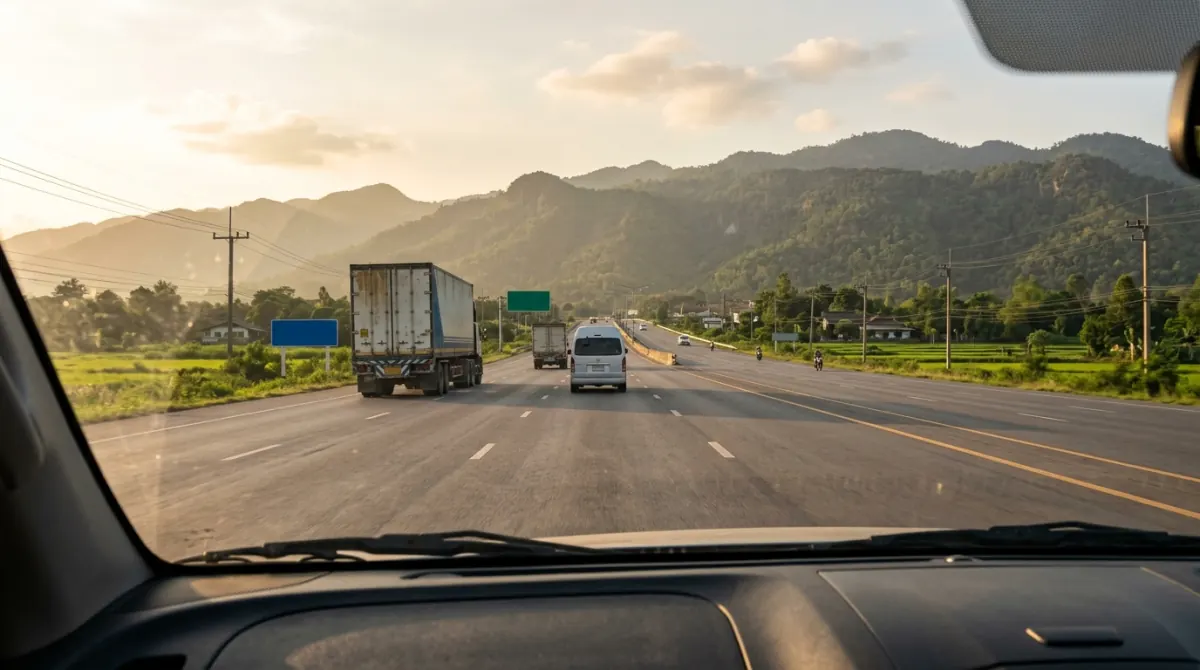
Khao Yai is 180–205 km northeast of Bangkok — 2 to 2.5 hours by road from Suvarnabhumi, 2.5 to 3 from Don Mueang. Trains and buses reach only Pak Chong town, about 23 km short of the park gate, and there is no transport of any kind inside the park itself.
At a glance
| Fact | Detail |
|---|---|
| Distance, Bangkok to the northern park gate | 180–205 km, depending on route |
| Drive time, Suvarnabhumi (BKK) → Khao Yai | 2–2.5 hours |
| Drive time, Don Mueang (DMK) → Khao Yai | 2.5–3 hours |
| Fixed private transfer, Suvarnabhumi (BKK) ↔ Khao Yai | Sedan 2,000 / SUV 2,300 / Van 2,800 THB one-way (the van is 3,000 back to the airport), tolls included |
| Airport meeting point | Suvarnabhumi: Floor 4 (Departures), Gate 4 · Don Mueang: Floor 3 (Departures), door given in the message we send the day before |
| Fastest train, Bangkok → Pak Chong | Special Express 21, 06:10 → 08:52 (2h 42m) |
| Bus or minivan, Bangkok → Pak Chong | 2.5–3.5 hours, roughly 180–290 THB (USD 5–9) per person |
| Pak Chong town → northern park gate | ~23 km, about 30 minutes |
| Northern gate → park Visitor Centre | 14 km |
| Park gate hours | 06:00–18:00 daily; no new entry after 18:00 |
| Speed limit inside the park | 60 km/h, enforced with speed guns |
Four ways in, compared
They differ less in how long they take than in where they leave you standing.
| Cost | Door-to-door from BKK | Comfort | Luggage | Who it suits | |
|---|---|---|---|---|---|
| Private car | 2,000–3,000 THB per vehicle, tolls included | 3–3.5 hours from landing | Air-conditioned, a seat each, hotel door to hotel door | 2–5 bags by vehicle size | Families, night arrivals, anyone staying on Thanarat Road |
| Bus or minivan to Pak Chong | ~180–290 THB per person, plus onward transport | 6–8 hours | Cramped in a minivan, better on a coach | One case; minivans are tight | Budget travellers with time and a plan for the last 23 km |
| Train to Pak Chong | ~36–392 THB per person (USD 1–12), plus onward transport | 6.5–9 hours | The best public option; second-class air-con is genuinely comfortable | Generous, no charge | Anyone who enjoys the journey and can travel on the railway's schedule |
| Self-drive | ~1,000–1,500 THB per day (USD 30–45) plus fuel and tolls | 3.5–4 hours including the rental desk | Yours to set | Whatever fits | Confident drivers staying three days or more who want a viewpoint at dawn |
What the table hides is that the public options are cheap only until the last leg — the fare to Pak Chong is a fraction of the cost of reaching the waterfalls.
Realistic door-to-door times
Drive times quoted anywhere, including here, are engine-running times. Door-to-door is the number that decides your day.
From Suvarnabhumi (BKK). Allow 45–60 minutes from wheels-down to sitting in a car — immigration, bags, the walk to the pickup point. Add 2–2.5 hours of driving and you reach a Thanarat Road hotel about 3 to 3.5 hours after landing. Land at 09:00 and you are at the gate by early afternoon. Land at 16:00 and you are not entering the park at all, because it shuts at 18:00.
From Don Mueang (DMK). Closer to the northbound highway, but the operator budgets 2.5–3 hours because the approach roads are less predictable than the motorway out of Suvarnabhumi — so 3.5 to 4 hours door-to-door. DMK arrivals skew late-evening and low-cost, which usually means reaching the hotel at night and starting the park next morning.
From central Bangkok. Roughly 2.5–3 hours, but the first 45 minutes of it is Bangkok. Leaving at 06:30 is a materially different trip from leaving at 08:30 — see the itineraries chapter for the day-trip arithmetic.
By public transport. Neither airport has a direct bus to Pak Chong. You transfer into Bangkok first — Mo Chit for buses and minivans, Krung Thep Aphiwat for trains — so six to eight hours airport-to-hotel is realistic.
The gap nobody warns you about
Public transport reaches Pak Chong town. It does not reach the park, and there is nothing inside the park to pick you up.
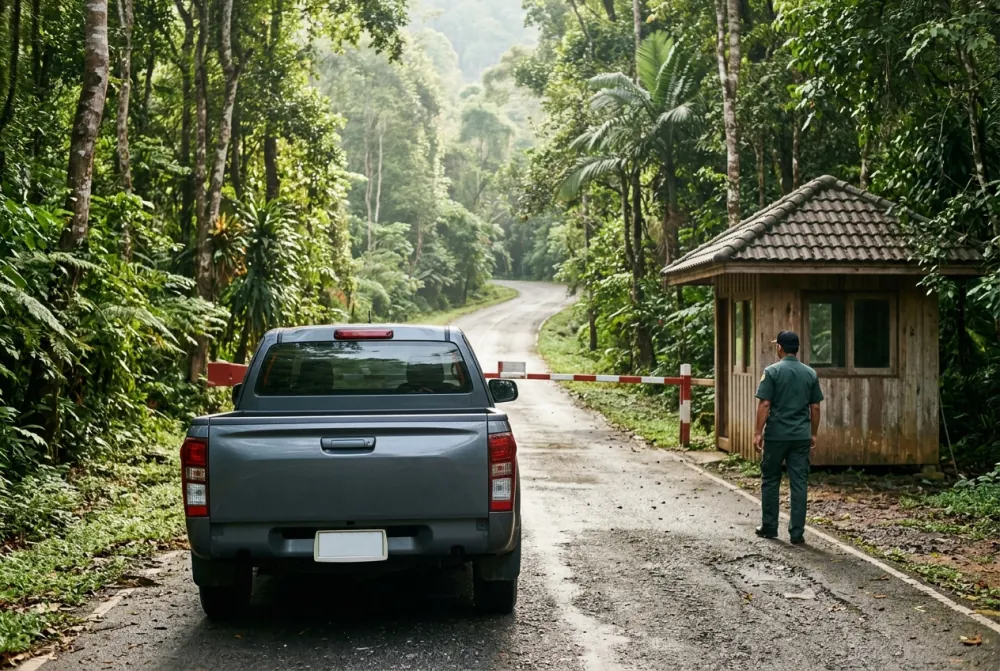
Pak Chong to the checkpoint is 23 km; the checkpoint to the Visitor Centre another 14 km; Haew Suwat about 10 km beyond that; and Haew Narok 22 km past the Visitor Centre on a different road, roughly 36 km from the gate. The orientation chapter has the full distance table with drive times. There is no bus, shuttle or scheduled service anywhere inside the boundary. Grab works patchily around Pak Chong and effectively not at all inside the park, where mobile signal is poor. Arrive by train and songthaew with no onward plan and you are standing at a barrier, 36 km short of the park's best-known waterfall.
Your options without a car:
- Songthaew to the gate. The blue songthaews leave from the stand on Mittraphap Road near the 7-Eleven and night market, south of the railway station. About thirty minutes to the checkpoint, and they do not continue inside. Reported fares run from 15 THB (the park's own site) to 30–50 THB in most independent accounts, and 150 THB for what looks like a bookable shuttle rather than the public service. Nobody publishes a timetable: the last run back down to Pak Chong is reported anywhere between 16:00 and 18:30. Ask the driver who takes you up what time he stops, and treat his answer as the only one you have.
- Hitching inside the park. Widely done and generally straightforward at weekends, when Thai families are driving the same loop. On a weekday the traffic it relies on is largely not there, and a solo traveller waits longer than a pair. A real option, not a schedule. Be back at the gate by mid-afternoon rather than counting on a lift at 17:00.
- A hired vehicle from Pak Chong. A songthaew driver or taxi will run you in for the day by negotiation. Scooter hire is roughly 300 THB a day in town, more at the park entrance; a car roughly 1,000–1,500 THB. The shorter run most train arrivals actually need first — Pak Chong station to a Thanarat Road hotel — has no published tariff at all and is negotiated at the rank, so agree the price before the bags go in.
- A guided day from Pak Chong, or a private car and driver for the day — the only option on this list that reaches the far waterfalls and the viewpoints without a second negotiation at the gate.
- Ranger-led hikes booked at the Visitor Centre include transport to the trailhead — but you must reach the Visitor Centre first.
Which gate: Pak Chong or Prachinburi
Khao Yai has two fee-collecting entrances at opposite ends of a road that runs about 50 km through the park. Almost everyone wants the northern one.
The northern gate — officially the Chao Por Khao Yai Shrine checkpoint, usually called the Pak Chong entrance — sits at the km 23 marker on Thanarat Road (Highway 2090) in Nakhon Ratchasima. It is the shorter, better-signposted run from Bangkok, and the side everything else is on: the train and bus connections, virtually all the hotels, the Thanarat Road attractions, the wineries, and the Visitor Centre where guides, the night safari and bungalow keys are handled.
The southern gate — Noen Hom, in Mueang district, Prachinburi — is reached on Highway 3077 via Nakhon Nayok, about 190 km from Bangkok. It is markedly quieter and it puts you close to Haew Narok. It suits drivers already east of Bangkok, or anyone crossing the park and exiting rather than doubling back; you may enter by one gate and leave by the other on one ticket.
That 190 km looks shorter on paper but is not a shortcut: it leaves you at the far end of the park from the Visitor Centre, the hotels and Thanarat Road. Unless Haew Narok is the reason for the trip, use the north.
Self-driving: roads, the mountain section and the dark
The roads are better than most first-time visitors expect. Highway 2 (Mittraphap) is a fast divided highway, and Thanarat Road climbs from Pak Chong in sweeping, well-maintained curves. The through-road inside the park is also sealed and in good condition, with frequent speed bumps. No four-wheel drive is needed.
Motorway 6 (M6) is newer and mid-rollout. As of late August 2026 the Pak Chong–Nakhon Ratchasima section is open 24 hours toll-free, while the 110 km Bang Pa-in–Pak Chong section is toll-free at weekends only, noon Friday to midnight Sunday, on a trial running to 25 December 2026. During the trial the limit is 80 km/h, motorcycles are barred, and there is no fuel or EV charging — only toilets and drinks at the Thap Kwang and Sikhio rest areas.
Rules and hazards on the park roads:
- The limit inside the park is 60 km/h, alongside a reported 95-decibel noise limit. Since September 2024 rangers have run inspection points on Thanarat Road with speed guns and sound meters, and have issued fines.
- There is no petrol station inside the park, and no ATM. Fill the tank and draw cash in Pak Chong before you drive up; the food and practical chapter covers what you need cash for once you are inside.
- Park roads are narrow and unlit, often one lane each way, with macaques sitting on the tarmac.
- You may not drive around the park after dark looking for animals. The fine is reported at 500 THB, and the only legal after-dark option is the ranger-run night safari, covered in the national park chapter.
In January 2026 motorists were warned about wildlife crossing two rural boundary roads, NM.3052 and NM.1016, after repeated collisions with elephants and gaur; 19:00 to 06:00 was the stated risk window, and further warnings followed in May. This is a recurring hazard, not a freak event.
Meeting your driver at the airport
Cars cannot wait in the arrivals lane at either Bangkok airport, so pickups happen on the departures level. At Suvarnabhumi the meeting point is Floor 4 (Departures), Gate 4: from Arrivals on Floor 2, take the lift to Floor 4 and cross one crosswalk to the pickup lane. At Don Mueang it is Floor 3 (Departures), and the exact door is in the message we send the day before. This is operator practice rather than an airport rule, so check the meeting point printed on your own booking rather than assuming it.
Night arrivals carry no surcharge. What a late landing costs you is the next morning, not money: the park gate opens at 06:00 and the wildlife hour is the one either side of it, so a 23:00 touchdown usually means writing off your first dawn rather than paying for the inconvenience. If that dawn is the reason for the trip, an earlier flight is worth more than a cheaper one.
Waiting allowances, meet-and-greet options and what happens when a flight runs hours late are booking terms rather than travel facts; they are on the booking page.
Frequently asked questions
How do you get from Bangkok to Khao Yai?
By road in 2 to 3 hours, or by train or bus to Pak Chong town in about three hours, plus another 30 minutes to the park gate. There is no airport at Khao Yai and no direct public transport from either Bangkok airport. A private transfer from Suvarnabhumi is 2,000–2,800 THB per vehicle.
Is there a train to Khao Yai?
There is a train to Pak Chong, 23 km short of the park gate, not to Khao Yai itself. Roughly six or seven services a day leave Krung Thep Aphiwat Central Terminal, taking 2h 42m to 3h 49m, and they routinely run late. Departures cluster in the early morning and late evening, so the practical choice is the 06:10 or the 07:10. Sources disagree on how many trains actually run and on what they cost, and the State Railway's own printed timetables and its ticketing site do not always match — check the day you travel at dticket.railway.co.th rather than trusting any second-hand figure, this one included.
Can you visit Khao Yai without a car?
Yes, but not easily. Public transport ends at the checkpoint and there is no bus, shuttle or taxi network inside the park, where attractions sit 10 to 36 km apart. The realistic answers are a rented scooter, a hired driver for the day, a guided tour from Pak Chong, or hitching, which is common at weekends and much less dependable midweek.
How long is the drive from Bangkok to Khao Yai?
Two to two and a half hours from Suvarnabhumi, two and a half to three from Don Mueang or central Bangkok. Add roughly an hour to that for immigration, bags and reaching the car. Weekend and holiday traffic on the Korat corridor can add an hour in either direction.
Which Khao Yai park entrance is best?
The northern one, at the Chao Por Khao Yai Shrine checkpoint on Thanarat Road near Pak Chong. It is the shorter drive from Bangkok, and the hotels, wineries, Thanarat Road attractions and the Visitor Centre are all on that side. The southern Noen Hom gate suits Haew Narok and drivers coming from the east.
Is it safe to drive around Khao Yai at night?
The roads are sound but unlit, narrow and shared with wildlife. Elephants and gaur cross rural boundary roads between 19:00 and 06:00, and collision warnings were issued twice during 2026. Driving inside the park after dark to look for animals is prohibited and carries a fine reported at 500 THB.
Keep reading
- Fixed transfer fares, vehicle sizes and airport pickup details are on the booking page.
Last updated: 2026-09-19. Route timing and road notes come from Smile Taxi Service drivers who run Khao Yai tours weekly.