
Khao Yai Travel Guide · Chapter 1 of 8
Khao Yai at a Glance: The Park, Pak Chong and Thanarat Road
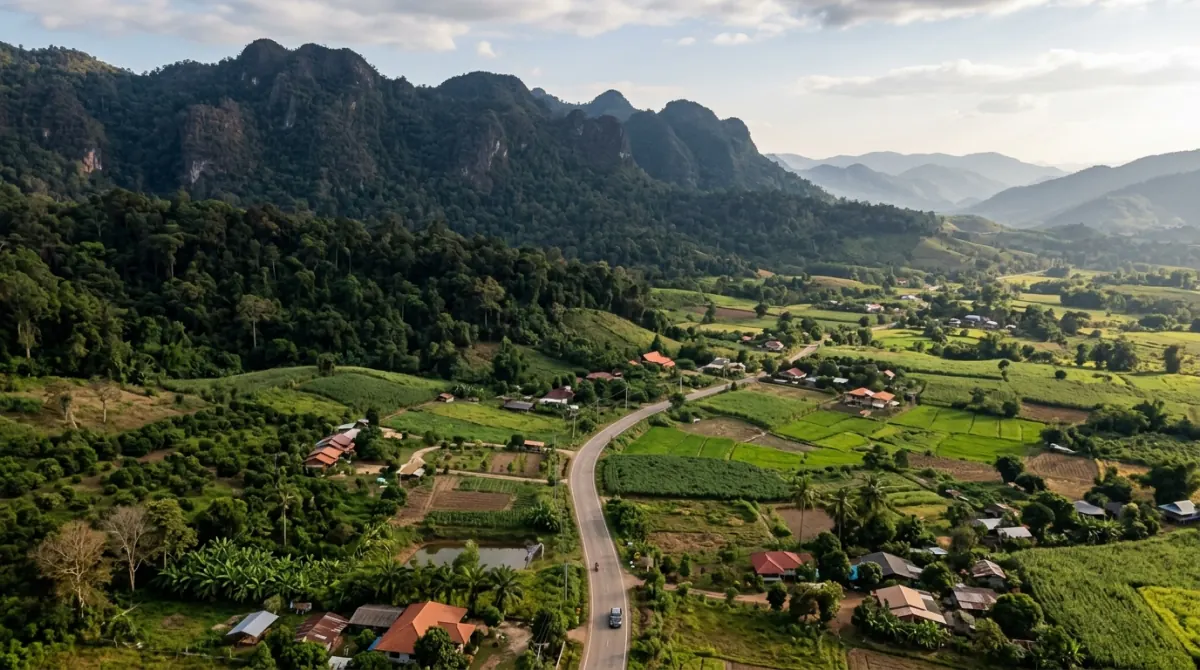
Khao Yai is two places sharing one name. The national park is a 2,168 km² protected forest about 180 km northeast of Bangkok. The wineries, alpaca farms and Italian-style villages sold as "Khao Yai" sit outside it, on and around Thanarat Road between Pak Chong town and the park's north gate. Plan them as separate days.
At a glance
| Fact | Detail |
|---|---|
| Province | Nakhon Ratchasima; the park also reaches into Prachinburi, Saraburi and Nakhon Nayok |
| Distance from Bangkok | ~180 km northeast to Pak Chong. The park's own site quotes 205 km to the north gate, which is a further 23 km up Thanarat Road |
| Drive time | 2–2.5 h from Suvarnabhumi (BKK); 2.5–3 h from Don Mueang (DMK) |
| Park established | 18 September 1962 — Thailand's first national park |
| Park area | 2,168 km² |
| Elevation | Roughly 700–1,300 m across the park; Khao Rom, the high point, 1,351 m. Pak Chong and Thanarat Road sit far lower, around 350 m |
| UNESCO status | Inscribed 14 July 2005 as part of the Dong Phayayen–Khao Yai Forest Complex |
| Park gates | 06:00–18:00 daily. Visitor Centre desk 08:30–16:30 |
| Foreign entry fee | 400 THB adult (approx. USD 12), 200 THB child. Thai rate 40/20 THB. Valid for one day |
| Pak Chong → north gate | 23 km on Thanarat Road (Route 2090), about 30 minutes |
| North gate → Visitor Centre | 14 km, 25–30 minutes at the 60 km/h in-park limit |
| Cool season | November–February. Nights at altitude can drop below 10°C. Chapter 7 has the month-by-month weather table |
Three zones, one name
Most attractions marketed as "Khao Yai" are not inside the national park.
Khao Yai National Park is the protected forest itself, behind a gate with an entrance fee. Inside it are the waterfalls, the viewpoints, the hiking trails, the ranger-run night safari and the wild animals. There are no shops, no bars and no resorts, and no ATMs or petrol stations inside the boundary, so carry cash and fill the tank in Pak Chong (Chapter 7 has the detail). Public transport reaches Pak Chong and stops there; nothing runs inside the park itself (Chapter 2). Alcohol is banned park-wide.
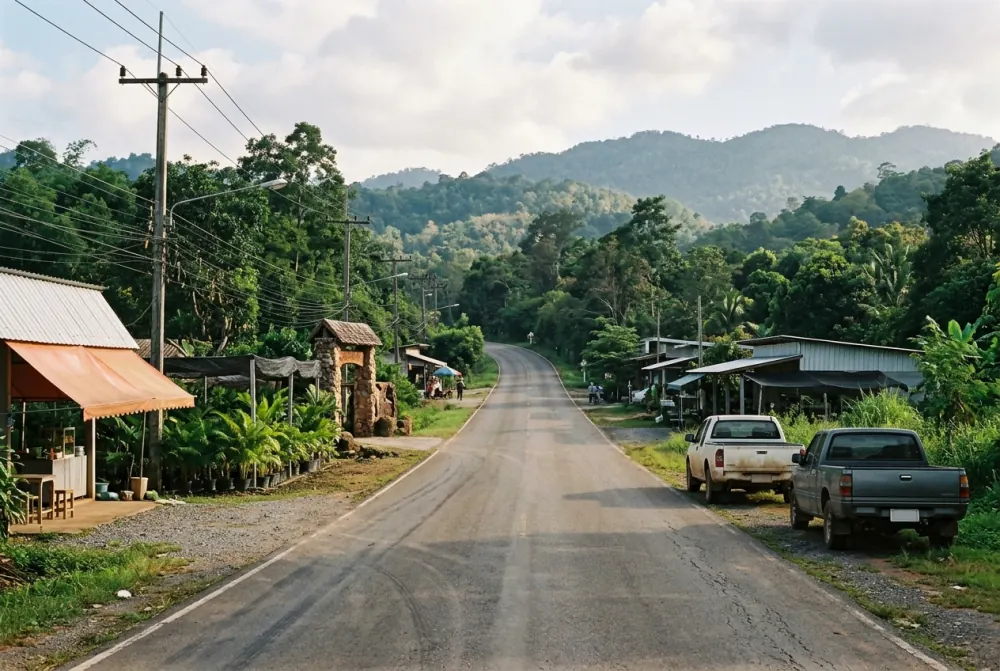
Thanarat Road, Route 2090, runs roughly 23 km south from Pak Chong up to the park's north gate. This is where the built attractions are: Primo Piazza, Midwinter Green, the sheep and alpaca farms, and most of the resorts people mean when they say they are "staying in Khao Yai". Palio, the mock-Tuscan village most listings still put at the head of that list, has been closed since March 2020 — you can park and photograph it, and that is all (Chapter 6). Scenical World is sold as part of the same run, but no source pins it to a km marker on this road, so treat its position as unconfirmed. None of it is inside the park. It is a strip of restaurants, photo villages and animal-feeding farms on a public road, and it is the busiest part of the area at weekends. Chapter 6 covers what is on the strip and which parts are worth your time.
Pak Chong is the town at the top of Thanarat Road, on Highway 2. It has the train station, the bus and minivan stops, the night market, the banks and the cheapest beds. Nobody comes for the town itself, but it is the transport hub and the last reliable place to draw cash and fill a tank.
The distances the itineraries leave out
Khao Yai's attractions are 20–40 km apart, and a good share of that is inside a park with a 60 km/h speed limit and frequent speed bumps.
| Leg | Distance | Allow |
|---|---|---|
| Bangkok → Pak Chong | ~180 km | 2–2.5 h |
| Pak Chong → mid-strip, Thanarat km 17 | 17 km | ~23 min |
| Pak Chong → park north gate (km 23) | 23 km | ~30 min |
| North gate → Visitor Centre | 14 km | 25–30 min |
| Visitor Centre → Haew Suwat waterfall | 10 km | 20–25 min |
| Visitor Centre → Haew Narok waterfall | 22 km | ~40 min |
| Pak Chong → PB Valley / GranMonte | ~20–30 km west | 30–40 min |
The in-park legs in that table are estimates worked from the posted 60 km/h limit and the state of the road, not figures the park publishes. Estimates for the Visitor Centre to Haew Suwat leg run between 20 and 25 minutes, which is why it is printed as a range rather than a single number. If you are timing a dawn start or a run back to the 18:00 gate, allow the top of each range.
From the north gate, Haew Narok waterfall is about 36 km one way — still inside the park. From a resort halfway up Thanarat Road, the Visitor Centre is roughly 25 km and the better part of an hour once you have queued at the gate. A winery west of Pak Chong plus a proper morning in the park means crossing the whole area twice.
That is why the popular "park plus winery plus Italian village in one day" plan tends to deliver ninety minutes at each stop and four hours in a vehicle. It is possible. It is just thinner than the photos suggest. Chapter 8 sets out what a day, a weekend and three days each realistically buy you.
What the national park actually is
Khao Yai was declared Thailand's first national park on 18 September 1962. It covers 2,168 km² of hill evergreen, dry evergreen and mixed deciduous forest with pockets of open grassland, and in July 2005 it was inscribed on the UNESCO World Heritage list as part of the Dong Phayayen–Khao Yai Forest Complex, a 230 km chain of protected forest running east toward the Cambodian border.
The main plateau sits between about 700 and 1,300 m, with Khao Rom at 1,351 m as the high point. That altitude is why the forest here is different from the lowland scrub either side of the highway, and why the park holds wild elephants, gibbons, hornbills, gaur and — thinly, secretively — clouded leopards.
Two gates serve it. The northern Chao Por Khao Yai Shrine checkpoint above Pak Chong is the one almost everyone uses, and it is where the Visitor Centre, the guides, the night safari and the bungalows are organised. The southern Noen Hom gate on the Prachinburi side is much quieter and mainly serves the Haew Narok end. A single road runs about 50 km through the park linking the two, so you can enter at one and leave by the other. Chapter 3 covers fees, hours, rules and wildlife in detail.
Cooler than Bangkok — but check the numbers before you pack
Comparing long-term averages, Khao Yai's daytime maximum runs roughly 2–4°C below Bangkok's: 29°C against 32°C in January, 33°C against 35°C in April. That is a real difference but not a transformative one, and it is much less than most visitors expect. You will still be warm at midday in April.
The gap opens up at night. Khao Yai's January minimum averages around 14°C against Bangkok's 21°C, and December is 15°C against 21°C. On the high ground and at dawn on the viewpoints, December and January readings below 10°C are normal. That is the "cool season" Bangkok residents drive up for, and it is a night-and-early-morning phenomenon, not an all-day one.
Altitude also decides how cool your trip actually feels. Pak Chong and the Thanarat Road resorts sit around 350 m — the two big vineyards both publish that figure for their sites — while the park interior and the viewpoints are 700 m and up. If you sleep on the strip and visit the park at midday, you will experience very little of the cold that Khao Yai is sold on.
Practically: pack layers rather than warm clothes. A fleece or light jacket for December–February evenings and early starts, a rain shell from May to October, closed shoes for trails, and insect repellent. Leech socks matter from roughly May to October — no official leech season is published, but the guide's own month tables put them on the trails from May. Chapter 7 has the month-by-month weather table and the full packing list.
Who Khao Yai suits, and who leaves disappointed
Khao Yai rewards people who commit to one thing per day and give it a proper morning.
It suits wildlife-minded travellers who will accept uncertainty, get up at first light, spend more than one day, and use the roads and grasslands at dusk. It suits wine and food travellers — Thailand's serious New Latitude vineyards are here, and Chapter 5 covers them properly. It suits families with young children, who often get more out of the dairy farm and the animal-feeding places than out of a forest walk. And it suits Bangkok weekenders who want two nights of cool air, a good restaurant and a drive with corners in it.
It disappoints three groups, consistently.
Anyone expecting guaranteed animal sightings will be let down. Macaques are near-certain and deer are likely, but wild elephants are a genuine possibility rather than an expectation, and a single midday drive-through is a poor bet. No credible source publishes an odds figure and neither will this guide.
Anyone expecting the Thanarat Road attractions to be nature will find built photo destinations: mock Italian villages, paid animal paddocks, cafes. Some are enjoyable. None of them is Khao Yai National Park, and several are busy enough at weekends to be unpleasant.
Anyone arriving without transport will find the geography works against them: the three zones sit 20–40 km apart on roads built for cars. Chapter 2 is specific about what buses, songthaews, hitching and ride-hailing can and cannot reach.
Frequently asked questions
What is Khao Yai known for?
Two separate things. It is Thailand's first national park, established in 1962 and UNESCO-listed, known for wild elephants, gibbons, hornbills and the waterfall from the film The Beach. Separately, the area outside the park is Thailand's main wine region and a weekend resort belt of farms, cafes and Italian-styled villages. Most visitors come for one or the other.
Are the Khao Yai wineries inside the national park?
No. PB Valley and GranMonte are both in Phaya Yen sub-district, reached off Highway 2 on the far side of Pak Chong from the park gate — around 20–30 km from town, in the opposite direction from Thanarat Road. No alcohol is permitted inside the national park at all. A winery visit and a park visit are two separate drives.
How far is Khao Yai from Bangkok?
About 180 km northeast to Pak Chong, the access town, or roughly 205 km to the park's north gate by the park's own reckoning. Driving takes 2–2.5 hours from Suvarnabhumi and 2.5–3 hours from Don Mueang, longer on Friday evenings and Sunday afternoons when Bangkok weekend traffic uses the same road.
Is Khao Yai cold?
Cooler than Bangkok, mostly at night. Daytime highs run about 2–4°C below Bangkok's. Overnight lows in December and January average around 14–15°C against Bangkok's 21°C, and can fall below 10°C on high ground. Bring a fleece for cool-season evenings and dawn viewpoints, but expect warm afternoons year-round.
Can you visit Khao Yai without entering the national park?
Yes, and many weekenders do. The wineries, farms, resorts, restaurants and photo villages are all outside the gate and need no entrance ticket. You will see no wild elephants, no waterfalls and no forest trails that way. If the park is what drew you, budget a full day for it rather than an afternoon.
Keep reading
- Fees, gate hours and what you will realistically see: Inside Khao Yai National Park
- Khao Yai day tours
Last updated: 2026-08-29. Route timing and road notes come from Smile Taxi Service drivers who run Khao Yai tours weekly.