
Khao Yai Travel Guide · Chapter 7 of 8
Eating, Sleeping and Practical Khao Yai
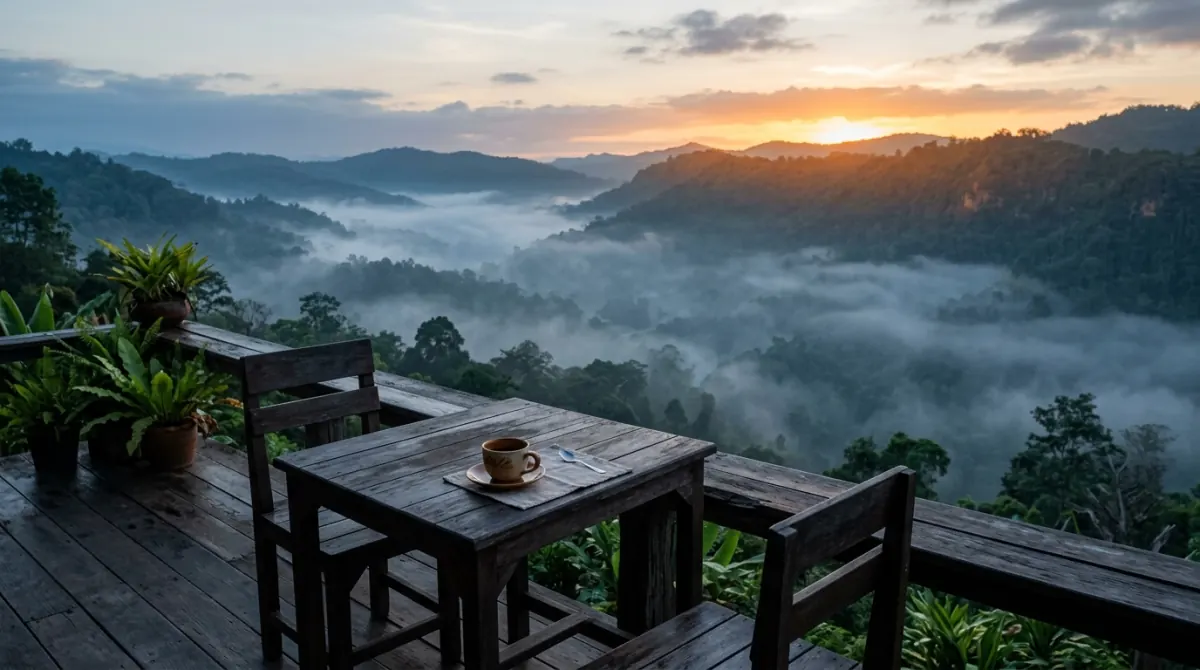
Thanarat Road resorts start around 1,800 THB and sit 5–25 minutes from the gate; Pak Chong beds run 600–1,200 THB but 23 km out; park bungalows from 560 THB put you inside at dawn. November to February is cool, dry and busiest. Carry cash — no ATMs inside the park.
At a glance
| Item | Detail |
|---|---|
| Park bungalow, 2 people, Thanarat zone | 560 THB weekday / 800 THB weekend (about US$17 / US$24) per building |
| Camping pitch, own tent | Reported at 30 THB or at 80 THB per person per night; the DNP publishes no figure. Confirm at the campground |
| Booking park accommodation | nps.dnp.go.th, up to 60 days ahead, maximum 3 nights, paid in advance |
| Bungalow keys | Collected at the Visitor Centre, which closes at 16:30 |
| Food inside the park | 6 restaurants, 4 drink kiosks. Mon–Fri 07:00–18:00, Sat–Sun 07:00–21:00. No alcohol |
| Pak Chong night market | Daily, roughly 17:00–22:00, off Mittraphap Road |
| Coldest month | January, low around 14°C; under 10°C possible at altitude |
| Wettest / driest month | September, around 294 mm / December, around 6 mm |
| Leech season | Roughly May to October. No official season is published |
| Peak tick-bite risk | November to February |
| ATMs and fuel inside the park | Neither. Sort both out before the checkpoint |
Where to base yourself
The gap between the three bases is not money. It is how far you are from the forest at six in the morning, which is when the park is at its best.
| Base | Rough nightly cost | Distance to the gate | The trade-off |
|---|---|---|---|
| Inside the park | 30–80 THB a pitch, 560–2,400 THB a bungalow | You are already inside | Plain rooms, early cut-offs, book two months out |
| Thanarat Road | 1,800 THB for mid-market; flagships far above that | 5–25 minutes | Comfortable, photogenic, faces away from the park |
| Pak Chong town | 600–1,200 THB | 23 km, plus 14 km more to the Visitor Centre | Cheapest and best connected, furthest from the point |
Inside the park. Two campgrounds, Lam Takhong and Pha Kluai Mai, with toilets, cold showers, a canteen and a shop; tents and bedding are rented on site, first come. Pitching your own tent is cheap, but the figure is genuinely unsettled: some sources give 30 THB per person per night, others 80 THB, and the DNP publishes no tariff at all. Carry small notes and settle it at the campground desk rather than budgeting to the baht.
Above them sit 27 government bungalows across four zones plus 16 camp houses — a two-person Thanarat-zone unit is 560 THB midweek and 800 THB at weekends, the larger Kong Kaew units 1,680 and 2,400 THB (about US$51 and US$73). Those bungalow rates come from khaoyainationalpark.com, not from the DNP booking portal, which does not publish a public price table; treat them as reported rather than official. The rooms are plain, and that is not the point. The point is that gibbons call at first light and you are already inside, without repaying the 400 THB (US$12) foreigner entry fee.
Booking is online at nps.dnp.go.th, up to 60 days ahead, maximum three consecutive nights, paid in advance. One date change is allowed, notified ten working days ahead; otherwise there are no refunds.
Thanarat Road. Almost every resort sits here, and it buys hot water, a pool and dinner minutes away. What it does not buy is proximity to wildlife: the checkpoint is a short drive, but the Visitor Centre is another 14 km inside and Haew Suwat 10 km beyond that.
Pak Chong town. Cheapest beds, plus the train station, bus and minivan drops, banks, the district hospital and the night market — but 23 km from the checkpoint, with no public transport past that barrier. See Getting to Khao Yai. It works on a budget if you have arranged wheels, and badly if you have not.
The resort scene, and why Bangkok made this a weekend habit
Khao Yai's accommodation market is built around Saturday and Sunday, and the timetables say so. Government bungalows carry a separate weekend rate and a reported 30% discount Monday to Thursday. Park restaurants close at 18:00 on weekdays and 21:00 at weekends. Chokchai Farm runs a couple of guided tours a day midweek and one every twenty minutes at weekends — the full timetable is in The Thanarat Road Strip.
The cause is distance and temperature: Bangkok is two to two and a half hours away and reliably warmer, and the strip has spent years building for people who leave the city on Friday evening. That produced a particular kind of hotel — design-led and themed rather than rustic.
The strip is really three price bands, and the 1,800 THB figure only describes the middle one. Farm stays, cabins and vineyard rooms sit at the bottom, from roughly 1,800 THB, including GranMonte's eight-room Wine Cottage — see Khao Yai Wine Country. Mid-market resorts with a pool and a restaurant run above that. The design-led flagships are a different market: the InterContinental Khao Yai Resort, built by Bill Bensley around restored heritage railway carriages, dusitD2 Khao Yai and the Michelin Guide-listed sala khaoyai were listed in five figures a night for a cool-season weekend when aggregators were checked in August 2026. If you are pricing a trip off the 1,800 THB floor, none of those three is in your search results.
Much of the strip, though, is Tuscan, Swiss or English pastiche built for photographs, facing the road rather than the forest. If the trip is about the national park, the resort is a bed and a breakfast. If it is about two comfortable nights out of Bangkok with a vineyard lunch, the strip is exactly that product and is good at it.
Eating: plan around the park, not inside it
The park publishes six restaurants and four drink kiosks for the entire protected area, clustered at the Visitor Centre and the two campgrounds. They serve simple Thai rice and noodle plates, and they take cash. Monday to Friday they close at 18:00, the same hour as the gate, which means an in-park dinner is not a fallback for a late finish — if you are still inside at six you are leaving, not eating. Only at weekends do they run to 21:00. Alcohol is banned everywhere inside the boundary, campgrounds included.
That is the whole list. Nothing inside is a meal worth driving for, and on a trail you carry your own water and food.
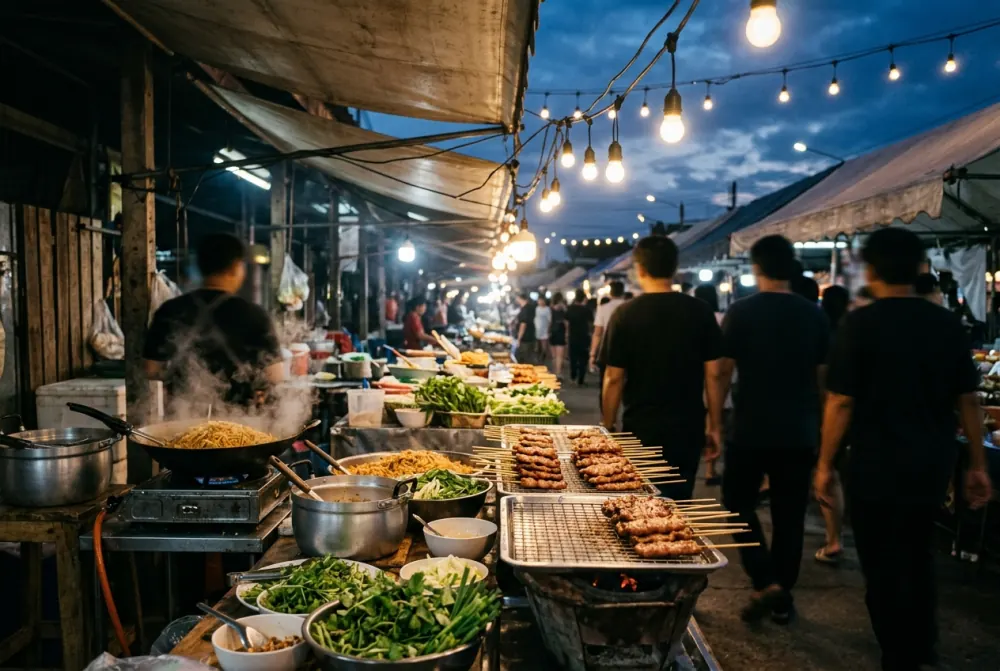
Outside the gate the picture changes completely.
- Thanarat Road eats better than its theme-park frontage suggests: roadside Isaan and noodle shops, grilled pork and som tam, several carried in the Michelin Guide's budget listings for Khao Yai and Korat. At the top end, Midwinter Green holds Michelin Guide recognition and runs a cool-season market alongside the restaurant; its season, hours and prices are in The Thanarat Road Strip.
- The winery restaurants are the set-piece lunches: the Great Hornbill at PB Valley, daily 11:00–20:00, and VinCotto at GranMonte. Both take reservations, and both involve wine on a mountain road.
- Pak Chong night market is the cheap answer: roughly 600 m of stalls off Mittraphap Road, daily about 17:00 to 22:00. Money goes furthest here.
Weather month by month
The park recognises three seasons: hot March to May, rainy June to September, cool October to February. Its climate page gives an average annual temperature of about 21°C, and December and January nights can drop below 10°C in the hills.
Take the park's cool season as a botanical description rather than a travel window. October still averages around 175 mm of rain over fifteen wet days, which is not a dry month by any reading. The cool-dry stretch you would actually plan a trip around is November to February, and that is the window the rest of this guide uses.
| Month | High / low | Rain, wet days | Character |
|---|---|---|---|
| January | 29°C / 14°C | ~9 mm, 2 days | Coldest nights, clearest air, peak season |
| February | 31°C / 17°C | ~26 mm, 3 days | Dry, warming fast; grape harvest under way since late January |
| March | 32°C / 19°C | ~52 mm, 5 days | Hot, hazy, waterfalls dropping |
| April | 33°C / 20°C | ~105 mm, 9 days | Hottest month; mid-April holiday fills the strip |
| May | 31°C / 21°C | ~192 mm, 17 days | Rain arrives, forest greens, leeches start |
| June | 30°C / 21°C | ~171 mm, 17 days | Properly wet; Pha Diao Dai closes on the 1st |
| July | 29°C / 20°C | ~188 mm, 18 days | Wet, quiet, cheap, leech-heavy |
| August | 29°C / 20°C | ~223 mm, 21 days | Rain most days; flash-flood closures possible |
| September | 29°C / 20°C | ~294 mm, 21 days | Wettest; waterfalls at their strongest |
| October | 28°C / 20°C | ~175 mm, 15 days | Rain easing, water high, closures lifting |
| November | 27°C / 17°C | ~39 mm, 5 days | Dry, cooling, decent water — best compromise |
| December | 27°C / 15°C | ~6 mm, 2 days | Driest and coldest; weekends book out |
No month is good at everything. The best weather months are the worst waterfall months: by March and April Haew Suwat can be a single strand. The best waterfall months are the wettest, the leechiest and the ones when sites shut — Pha Diao Dai has closed 1 June to 30 September in both 2025 and 2026, so treat it as annual and confirm on 086-092-6529 before you build a day around it.
March to May is the cheapest and quietest stretch of the year, with the lowest room rates and the park largely to yourself. What you give up is water. From roughly February to May Haew Narok can be a dry rock face, and it is 36 km each way from the north gate to find that out; April is the hottest month on the table. Those months are a bargain if you are coming for forest, park roads and wildlife, and a wasted drive if the waterfalls are the reason you are coming at all. The month-by-month water levels are in Khao Yai's Waterfalls and Viewpoints.
Packing, cash and phone signal
Pack for a mountain, not for Bangkok. Layers first — a fleece for December and January mornings and for the night safari, which runs in an open-backed pickup. A rain shell in any month. Closed shoes with grip for the waterfall staircases. DEET repellent, which handles mosquitoes, ticks and leeches together. A torch, a refillable bottle — foam containers are banned and you carry your litter out — and cash.
From roughly May to October add leech socks, which the park's own pre-trek checklist names as seasonal kit. They go on over your trouser legs. Some are available at the Visitor Centre, though sources disagree on whether they are sold or rented there and none of them publishes a price, so bring your own if you want the certainty. Guided walks generally supply them.
Money. There are no ATMs inside the park. The gate fee takes cash or the DNP QueQ e-ticket app by card or PromptPay, but the app needs signal, and whether it accepts a foreign card or registers on a non-Thai phone number is documented nowhere — no published source describes a visitor completing that payment on an overseas card, and PromptPay is not available to most foreign visitors at all. Treat QueQ as a convenience for residents rather than a route to rely on: carry 400 THB per foreign adult in notes, and buy any e-ticket before you leave the strip. Campground fees, canteens and kiosks are cash. On Thanarat Road, resorts and wineries take cards; small farms, roadside restaurants and market stalls often do not.
Signal. Coverage inside the park is patchy and there is no public WiFi. No carrier publishes a coverage map for the park and the DNP publishes nothing, so which specific points hold a signal is undocumented — the commonly repeated claim is that it works near the checkpoint, the Visitor Centre and the Lam Takhong campground and disappears on the roads out to the waterfalls, and that traces to a single travel site rather than to anyone who measured it. Plan for no signal anywhere past the gate: download offline maps, your accommodation address and the park's numbers before you get there.
Safety: the road, the forest floor and the ticks
Driving after dark, the wet-season forest floor and cool-season ticks account for most of the trouble here. The last of those is the one nobody plans for, because it peaks in the months everybody comes.
Roads. Park roads are narrow, usually one lane each way, and badly lit. Macaques sit on the tarmac near the gates; deer and elephants cross at dawn and dusk. Speed and noise limits inside the park, the enforcement checkpoints on Thanarat Road, the ban on driving around the park after dark and the boundary-road collision warnings are all set out in Getting to Khao Yai — read that before you drive yourself. What to do when an elephant is standing on the road is in Inside Khao Yai National Park, and the official protocol is not what most travel blogs say.
Leeches. From roughly May to October they are on wet trails in numbers — a nuisance rather than a danger. Nobody publishes an official season; May is where both this chapter's rainfall table and the waterfall chapter's month table put the start. The park's advice: cover arms and legs, wear shoes that protect the ankle, pull leech socks over trouser legs, and check yourself and your companions often, because leeches climb upward.
Ticks. This one runs against the seasons. A published survey of questing ticks collected around Khao Yai's tourist areas put the highest risk of human tick bites between November and February, when tick numbers and visitor numbers rise together — the same window as the best weather. Use repellent on shoes, ankles and trouser cuffs, check after any stop in long grass, and — since the pathogens found in those ticks include Rickettsia — show a doctor any fever in the days after a bite.
Medical help, and who can physically get there
There is no clinic inside the park boundary. The nearest full hospital is Pak Chong Nana Hospital, the district hospital in Pak Chong town — about 23 km from the checkpoint and roughly 37 km from the Visitor Centre, which is 45 minutes to an hour of driving from the middle of the park before anyone sets off. If you are hurt on a waterfall road you may also have no signal to call with, which is the practical reason to tell your accommodation where you are walking and when you expect to be back. Rangers at the checkpoint and the Visitor Centre are the first responders; the park's 24-hour emergency number is in Inside Khao Yai National Park. Travel insurance that covers a hospital transfer is worth more here than in Bangkok, where a taxi solves most of it.
With a pushchair, or with limited mobility. The DNP publishes no accessibility information for Khao Yai, so this is assembled from what each site physically is rather than from any official grading. Kong Kaew, beside the Visitor Centre, is about 100 m on the flat and the only sight here that is genuinely easy. Pha Diao Dai is a raised boardwalk, level once you are on it, but shut 1 June to 30 September. Haew Suwat is a staircase. Haew Narok is two kilometres return ending in a steep flight of about 50 vertical metres, and the climb back out is the part people underestimate. The park roads and the roadside viewpoints are all drivable, so a car-based day works; a waterfall-based one largely does not. Site-by-site detail is in Khao Yai's Waterfalls and Viewpoints.
Frequently asked questions
What is the best time to visit Khao Yai?
November to February for weather: cool, dry and clear, with lows around 14–17°C and only a handful of rainy days. It is also the busiest and priciest window, weekends book out, and it is the peak season for tick bites. September and October give the strongest waterfalls but heavy rain, leeches and seasonal closures. March to May is hot, quiet and cheapest, but Haew Narok can be a dry rock face and Haew Suwat a single strand — go then for forest and roads, not for water. November is the best all-round compromise.
Where should I stay in Khao Yai?
Thanarat Road for comfort and convenience: farm stays and cabins from roughly 1,800 THB, mid-market resorts above that, and design-led flagships such as the InterContinental, dusitD2 and sala khaoyai in a different bracket again. It is five to twenty-five minutes from the park gate. Pak Chong town for budget travel, around 600–1,200 THB, with the train station, banks and night market but 23 km from the checkpoint. Inside the park, from 560 THB for a two-person bungalow, if wildlife at dawn is the priority and a plain room is acceptable.
Can you stay inside Khao Yai National Park?
Yes. Two campgrounds rent pitches and tents — the fee for your own tent is reported as either 30 or 80 THB per person per night and the DNP publishes no figure, so confirm at the campground. Above them are 27 government bungalows and 16 camp houses across four zones, from 560 THB midweek for a two-person unit, though those rates are from khaoyainationalpark.com rather than the official portal. Book at nps.dnp.go.th up to 60 days ahead, maximum three consecutive nights, paid in advance with no refunds. Keys are collected at the Visitor Centre before it closes at 16:30.
Do you need cash in Khao Yai?
Yes. There are no ATMs inside the national park and no petrol stations. The gate fee can in theory be paid by card through the DNP QueQ app, but that needs mobile signal, which is unreliable, and nothing published confirms that the app works with a foreign card or a non-Thai phone number — carry 400 THB per foreign adult in notes rather than counting on it. Park canteens, kiosks and camping fees are cash only. Resorts and wineries on Thanarat Road take cards; small farms, roadside restaurants and market stalls frequently do not.
Is there food inside Khao Yai National Park?
Barely. Six restaurants and four drink kiosks serve the entire park, clustered around the Visitor Centre and the campgrounds, with simple Thai rice and noodle dishes. They open 07:00–18:00 Monday to Friday and 07:00–21:00 at weekends, and alcohol is banned throughout the park. Carry water and food if you are hiking, and plan real meals outside the gate.
Are there leeches in Khao Yai?
On wet-season trails, yes, roughly May to October — no official season is published, but May is where this guide's month tables put the start. They are not dangerous but they are persistent. The park lists leech socks as rainy-season kit; wear them over your trouser legs, cover arms and legs, use DEET repellent, and check yourself frequently because leeches climb upward. In the cool season they are largely absent — but ticks are at their peak instead.
Related
- Previous: The Thanarat Road Strip: Farms, Villages and Family Attractions
- Next: Khao Yai Itineraries: Day Trip, Weekend and Three Days
Last updated: 2026-08-29. Route timing and road notes come from Smile Taxi Service drivers who run Khao Yai tours weekly.