
Khao Yai Travel Guide · Chapter 5 of 8
Khao Yai Wine Country: PB Valley, GranMonte and the New Latitude
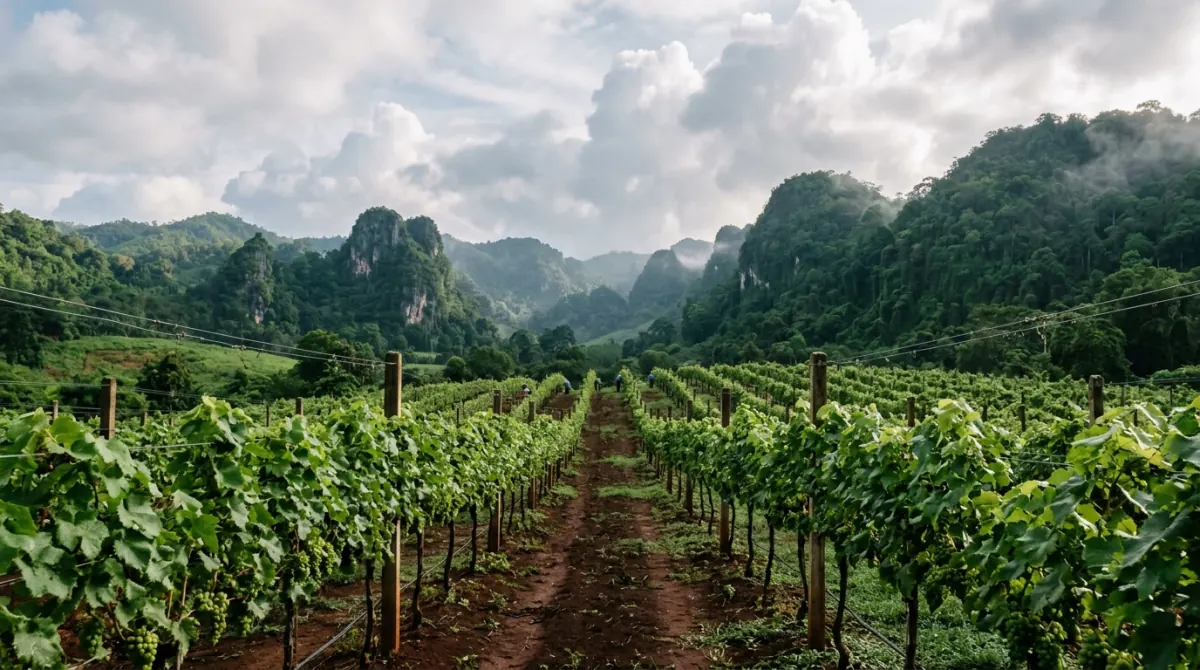
Khao Yai's two visitable wineries, PB Valley and GranMonte, sit in Phaya Yen off Highway 2 west of Pak Chong — a separate drive from the park gate, not on Thanarat Road. Both run daily guided tours with tastings; PB Valley needs booking 72 hours ahead, GranMonte takes walk-ins. Harvest is late January to mid-March.
At a glance
| Detail | |
|---|---|
| Latitude / elevation | About 14.3°N; vineyards at roughly 350 m, Alcidini nearer 550 m |
| Where the two big estates are | Phaya Yen subdistrict, Pak Chong — reached off Highway 2, not on Thanarat Road |
| PB Valley tour | 380 THB adult (approx. US$12), 300 THB child under 12 (approx. US$9), under 4 free |
| PB Valley tour times | 09:15, 11:15, 13:15, 15:15 daily; about 70 minutes |
| PB Valley booking | Required at least 72 hours ahead |
| PB Valley restaurant | Great Hornbill Winery Restaurant, 11:00–20:00 daily |
| GranMonte tour | Reported at 690 THB adult (approx. US$21), 590 THB under 20 (approx. US$18) — confirm on +66 94 831 0909 |
| GranMonte tour times | Reported as weekdays 10:00, 11:30, 13:30, 15:00, 16:00; weekends and public holidays 09:00, 10:00, 11:30, 13:30, 15:00, 16:30 |
| GranMonte booking | Walk-ins accepted; reservation strongly recommended |
| Grapes that work here | Chenin Blanc, Syrah/Shiraz, Durif, Tempranillo, Verdelho, Viognier |
| Harvest | Late January to mid-March |
| Drink-driving limit | 0.05% BAC (0.02% if under 20, or licence held under five years) |
Why grapes grow at 14 degrees north at all
Khao Yai sits at about 14.3 degrees north — some sixteen degrees closer to the equator than the band between 30 and 50 degrees where wine grapes have historically been grown. "New Latitude wine" is the trade term for wine made outside that band — Thailand, Vietnam, India, Brazil, Kenya. It describes geography, not quality.
Elevation is what makes it possible. PB Valley's vineyards sit at 350–380 m and GranMonte's at around 350 m, high enough that nights cool and the grapes hold acidity they would lose on the plain. The rest is engineering: growers manufacture a growing season the climate does not supply.
In a temperate region winter forces the vine dormant. Here nothing does, so pruning has to. Vines are cut back hard around April, before the monsoon, pushing the plant into growing canopy through the wet months instead of ripening fruit in the rain. A second prune in September or October, as the rains ease, triggers the fruiting cycle; roughly 120 to 130 days later the grapes ripen through the cool dry season. Two pruning seasons, one crop a year.
The difficulty in the tropics is not getting grapes ripe but slowing them down and keeping fungal disease off them. Fruit is picked by hand at night, before 6am, to reach the winery cold.
PB Valley Khao Yai Winery
PB Valley is the large one: 2,500 rai (about 400 hectares) at Phaya Yen, Pak Chong, planted with Shiraz, Tempranillo and Cabernet Sauvignon for the reds, Chenin Blanc and Colombard for the whites, plus table grapes and orchards that crop year-round.
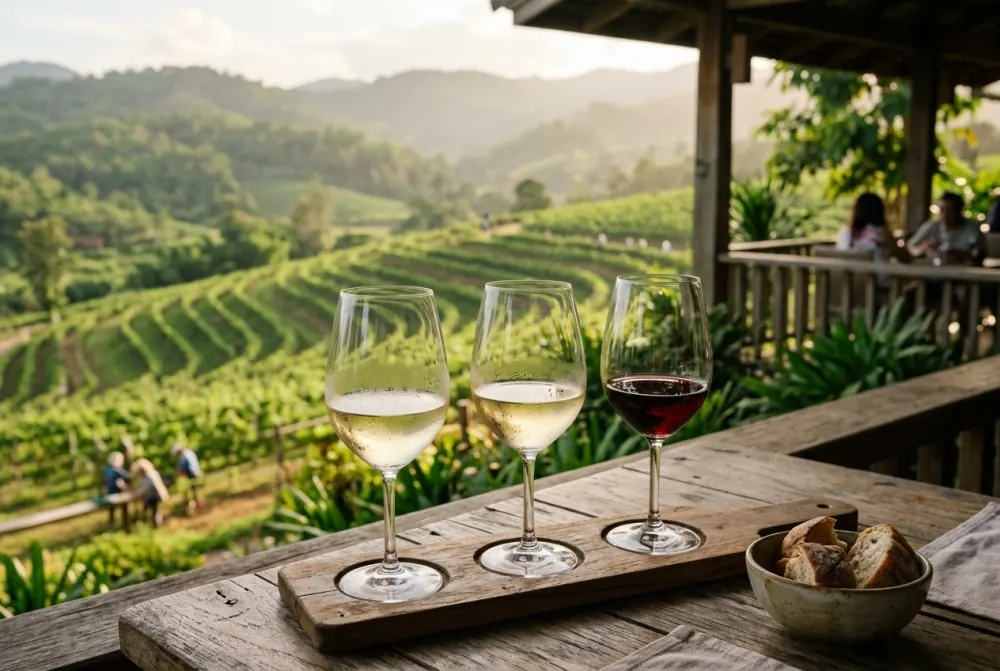
The Vineyard and Winery Tour runs four times daily and takes about 70 minutes: a guided walk through the vineyard and the dragon fruit and passion fruit orchards, then the winery, then a three-wine flight. Vintages rotate, so do not go expecting a particular bottle; the shape has held steady — an imported reference white, a Reserve Chenin Blanc and a Reserve Shiraz. Under legal drinking age, you get grape juice.
The imported pour is worth flagging. One of the three glasses on a Thai winery tour has consistently been an Australian Chardonnay, poured as a benchmark. If the point of the trip is Thai wine, you are tasting two.
Booking is required no less than 72 hours ahead, with phone numbers published for anything later. PB Valley publishes no opening hours for the grounds, the shop or the tasting room — the only stated hours anywhere on the site are the Great Hornbill Winery Restaurant's, 11:00 to 20:00 daily, for Thai, Western and wood-fired pizza. If you want to be on the property outside a booked tour slot, email [email protected] and ask rather than assuming the gate is open. A cooking class runs at 1,800 THB (approx. US$55) per person, minimum four.
GranMonte Vineyard
GranMonte is the family estate, and the difference shows in how the visit is run. Visooth and Sakuna Lohitnavy planted it in 1999 on family land in Asoke Valley that had been growing corn and cashews. Their daughter Nikki has been the winemaker since 2008; she trained in oenology and viticulture at the University of Adelaide and was Thailand's first fully qualified winemaker. The estate is 100 rai (40 acres) under vine at about 350 m, with a further 200 rai elsewhere in Khao Yai.
The planting is more ambitious than PB Valley's: Syrah, Cabernet Sauvignon, Durif, Grenache, Chenin Blanc, Verdelho, Viognier, Sauvignon Blanc and Semillon, with Merlot, Malbec, Barbera, Marsanne and Roussanne alongside.
The tour is listed at 690 THB for adults and 590 THB for under-20s, who get grape juice. It runs about an hour and a half with an English-speaking guide: a vineyard walk on how tropical grape growing works, then the winery, then four wines with matched bites including cheeses made locally in Khao Yai. Walk-ins are welcome, though booking is sensible at weekends.
VinCotto, the restaurant on the estate, cooks around the vineyard's own produce and pairs to the house wines. The eight-room GranMonte Wine Cottage sits on the property — the practical answer for anyone who wants to taste properly and not drive afterwards.
What GranMonte does not publish is anything you would use to plan around it. There are no opening hours anywhere on granmonte.com for the vineyard, the shop or VinCotto, and no room rate for the Wine Cottage. The tour times above come from third-party listings, not the estate. One call to +66 94 831 0909 settles the lot: booking, the hour you can arrive, a table at VinCotto and a room price. Make it before you build a day around the place.
Alcidini and the smaller producers
Alcidini is Thailand's smallest winery, making roughly 1,600 cases a year at Wang Katha in Pak Chong district. Going since 2001, it sits at about 550 m — higher than either big estate — on around 40 acres of which about 20 are planted, all Shiraz and Muscat Blue, grown without pesticides on Thailand's only Lyre trellis. The owners often pour the tasting themselves.
There is no polished tour operation here and no published schedule or price. That is both the point of the place and its limitation: it suits someone who genuinely likes wine and wants an hour with a grower, and it will bore anyone brought along for the scenery. Phone ahead rather than turning up.
Village Farm & Winery is the fourth name that comes up: a working vineyard with a tasting room and rooms, but in Wang Nam Khiao district on the far side of the massif — a separate outing, not a stop on a two-winery day. Nobody writing this chapter has been through its tour, and the winery publishes neither a tasting format nor a price, so it appears here as a name rather than a recommendation. It is worth an afternoon if you are already sleeping on that side of the park; it is not worth crossing the massif for on the strength of what can be confirmed about it.
What the wine actually tastes like
Chenin Blanc is the region's most convincing grape: citrus and passion fruit with real acidity, which is the hard part in a hot climate and the thing Khao Yai gets right most consistently. Verdelho and Viognier work in the same register. Syrah is the most reliable red — mid-weight, peppery, savoury rather than jammy. Durif, better known as Petite Sirah, gives the darkest and firmest wines here and is essentially a Khao Yai speciality. Tempranillo at PB Valley lands lighter, on red fruit and soft oak.
These wines do not compete with Bordeaux or Barossa, and nobody serious in Khao Yai pretends otherwise. The limits are concentration and length: the reds finish shorter than the same grape from a temperate climate, and excise duty means a good local bottle costs more than an import of comparable quality. What the region does well is fresh, high-acid whites and rosés that go with Thai food better than most imports, and a Syrah that drinks well slightly chilled when it is 32°C outside.
Judged as wine from a place that should not ripen grapes at all, it is a real achievement and often genuinely enjoyable. Judged blind against a mid-priced European bottle, it is not there. Both are true, which is why you taste before buying a case rather than after.
Harvest season, and planning the day
Harvest runs from the end of January to the middle of March, exact dates varying by variety. GranMonte turns it into a ticketed programme: Harvest Season 2026 ran 13 February to 15 March and 2025 ran 10 February to 16 March, so a mid-February to mid-March window is the pattern to plan around. It adds hands-on picking, winery access, harvest-only tastings and three-course menus at VinCotto, plus a one-day festival with picking competitions and live music.
Outside the harvest weeks the vines carry no fruit: from April to December the vineyard walk is a walk between trellises, and the substance of the visit is the winery and the tasting room. Anyone travelling specifically to see a vineyard working should aim at February or early March — also the tail of the cool dry season, and the best time to be in the park anyway.
The 2027 dates have not been announced; as of August 2026 GranMonte has published nothing beyond the 2026 season. If you are planning that far ahead, book around mid-February to mid-March on the strength of the two-year pattern, then confirm the exact window with the estate before you commit to anything non-refundable.
Doing both tours in one day is possible, since the estates are minutes apart, but the content overlaps heavily; one tour plus lunch at the other makes better use of the day.
If you only do one, do GranMonte. The tour runs about twenty minutes longer, the tasting is four wines with matched local cheeses rather than three pours of which one is imported, and the guiding is pitched at someone who wants to understand tropical viticulture. It costs about 310 THB more, and it is worth about 310 THB more. Pick PB Valley instead if you are on a budget or travelling with children: the orchards and table grapes give a child something to do that a trellis walk does not, and the Great Hornbill is the easier lunch for a group that is not all drinking. Doing GranMonte's tour and eating at the Great Hornbill is a reasonable way to have both.
Both estates sit off Highway 2 rather than on the Thanarat strip — see the three zones for what that does to the shape of a day.
Frequently asked questions
Are there wineries in Khao Yai?
Yes — Khao Yai is Thailand's main wine region. Two estates are set up for visitors, PB Valley Khao Yai Winery and GranMonte Vineyard, both in Phaya Yen near Pak Chong, plus the much smaller Alcidini. None is inside the national park.
Is Thai wine any good?
Better than most visitors expect, and not as good as the marketing suggests. Chenin Blanc and Syrah are the successes — fresh acidic whites and mid-weight peppery reds that suit the food and the heat. The reds lack the concentration of temperate-climate wine, and excise duty makes good local bottles cost more than comparable imports.
Do you need to book a Khao Yai winery tour?
At PB Valley, yes: reservations are required at least 72 hours ahead, with a phone line for anything later. GranMonte accepts walk-ins but recommends booking, and weekends and the February–March harvest season fill up. Reserve restaurant tables at VinCotto and the Great Hornbill rather than chancing a Saturday.
When is grape harvest in Khao Yai?
Late January to mid-March. GranMonte runs a formal Harvest Season within that window — 13 February to 15 March in 2026, 10 February to 16 March in 2025 — with picking, harvest-only tastings and special menus. The 2027 dates have not been announced yet. Outside the harvest period the vines carry no fruit, so the vineyard walk is much less interesting.
Can you visit Khao Yai wineries without a car?
Not easily. Both estates sit several kilometres off Highway 2, public transport gets no closer than Pak Chong (how you get here), and ride-hailing coverage around the town is patchy. The realistic options are a car and driver for the day, a hotel shuttle where one exists, or a room at GranMonte's Wine Cottage. Self-driving after a tasting is a poor plan regardless.
Related
- Previous: Khao Yai's Waterfalls and Viewpoints
- Next: The Thanarat Road Strip: Farms, Villages and Family Attractions
- A full day with a car and driver covers a two-winery day with lunch — the usual answer to the drink-driving problem.
Last updated: 2026-08-29. Route timing and road notes come from Smile Taxi Service drivers who run Khao Yai tours weekly.